
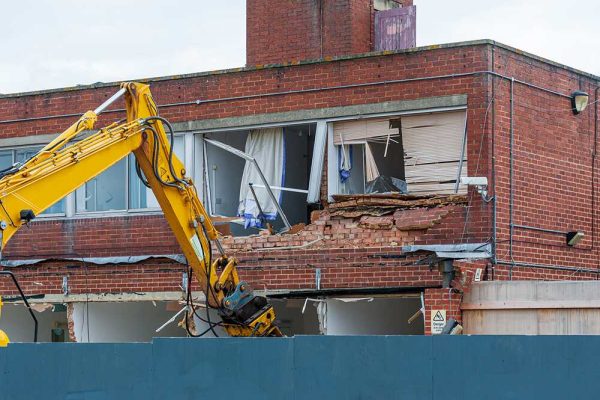
A contractor converts a 100-year-old shop into a doctor’s surgery. Internal walls come out, both roofs are stripped, some underpinning goes in. Weeks later, cracks appear in the neighbour’s bathroom. An engineer points to vibration from the works.
The claim goes in three times. Public liability says no, the contractor wasn’t negligent. Contractors’ all risks says no, that’s not the works being built. The employer’s existing structures policy says no, vibration isn’t a specified peril.
Only the JCT 6.5.1 non-negligent damage policy responds. Settlement: just under £994,000.
Three policies in place. One that pays. That’s the gap this article is about. If you take on demolition work in the UK, whether that’s a single load-bearing wall in a refurbishment or a tower block coming down, the cover question matters before the first hammer swings. Below is what standard policies miss, what demolition insurance actually involves, and how to stay on the right side of a six-figure claim letter.
What Demolition Insurance Actually Means in the UK
Demolition insurance isn’t a single policy. It’s a package built around the way demolition work goes wrong, which is rarely the way construction work goes wrong.
A properly arranged programme usually combines:
- Public liability with the FLEA restriction stripped out
- A contractors’ all risks section that names demolition as an accepted activity
- JCT 6.5.1 non-negligent damage cover where the contract calls for it
- Asbestos liability cover linked to a current R&D survey
- Plant cover for owned and hired-in demolition machinery
Insurer appetite has tightened. Claim frequency in demolition sits well above the construction average, with major claims often into six figures. Several mainstream insurers have pulled out or added height limits and method restrictions.
This isn’t only an NFDC-contractor concern. Principal contractors carrying out demolition in-house, refurbishment specialists doing soft strip, façade retention contractors, developers managing site clearance, and self-builders demolishing existing dwellings all sit in the same risk category. The line between PL and EL cover matters here too: NFDC members must hold demolition-specific PL and EL as a condition of membership.
The starting point is the business description on your policy. If “demolition” doesn’t appear with a realistic turnover split, the claim conversation gets difficult before it even starts.
Why Standard CAR Falls Short on a Demolition Site
CAR is built around adding to a site. Demolition takes from one. The shortfall sits in two places: the exclusions inside the CAR section, and the FLEA restriction inside public liability cover.
The Exclusions Inside CAR

Most standard CAR wordings exclude or restrict the following on demolition work:
- Vibration damage to surrounding property
- Weakening or removal of support to adjoining structures
- Subsidence, ground heave, and lowering of groundwater
- Collapse not caused by a specifically insured peril
- Damage to existing structures retained during partial demolition
These aren’t buried technicalities. They are the headline risks on a demolition site. Vibration is what breakout produces. Weakening of support is what happens when you take out a load-bearing element. Damage to retained structures is what façade retention creates by definition. When those exclusions stand, CAR is responding to almost nothing demolition actually causes.
The FLEA Restriction Hidden in PL
FLEA stands for fire, lightning, explosion, and aircraft. Many public liability wordings restrict damage to surrounding property to those four perils only. For a builder doing extensions, that’s usually fine. For demolition public liability insurance, it’s close to useless. The most likely third-party damage on a demolition site comes from vibration, collapse, dust, or ground movement. None of those are FLEA perils.
The Gold v Patman Gap and Why JCT 6.5.1 Exists
In 1958, a court case called Gold v Patman & Fotheringham set a principle that still shapes UK construction insurance. The property owner (the employer in JCT terms) can be liable in tort to a neighbour for damage from building works, even where the contractor was not negligent.
That created a hole. Public liability needs negligence to respond. The contractor has followed the method statement and met every health and safety duty, but the neighbour’s property still cracks. Who pays?
JCT contracts answered with clause 21.2.1, now renumbered 6.5.1. The contractor takes out non-negligent damage cover in joint names with the employer. The contractor pays the premium. The employer is indemnified.
The clause names a specific list of perils: collapse, subsidence, heave, vibration, weakening or removal of support, and lowering of groundwater. Each one maps directly to something demolition routinely does. If your JCT contract has 6.5.1 in the particulars, your PL alone will not satisfy it.
The Cover Extensions Demolition Contractors Need
A properly arranged CAR and liability package with the right extensions will often respond without a separate standalone policy. The question is which extensions, and whether they’re placed.
Non-Negligent Damage (JCT 6.5.1) Cover
This closed the Gold v Patman gap. It responds to the six named perils, in joint names with the employer. Place it with the same insurer as your PL where possible.
Adjacent and Adjoining Property Cover
This removes the FLEA restriction for surrounding property and broadens cover to the perils demolition actually creates. For city-centre work, terraced housing, or any site touching a third-party structure, it’s rarely optional. It also sits alongside Party Wall etc Act 1996 obligations.
Asbestos Liability Cover
Asbestos is excluded as standard in most public liability wordings. For pre-2000 buildings (most refurbishment and demolition work in the UK), that creates real exposure. Soft strip is the highest-risk activity, because the materials disturbed most often contain ACMs: ceiling tiles, insulation board, artex, pipe lagging, floor tiles. The same risk pattern shows up in renovation cover gaps.
Plant, Hired-In Plant, and Continuing Hire
Demolition relies on high-value plant: high-reach excavators, crushers, shears. Most is hired in. If a hired-in machine is damaged on site, the hire company keeps charging daily hire while it’s off the road. Continuing hire charges need to be specifically insured.
R&D Asbestos Surveys and Pre-Start Compliance
Before refurbishment or demolition starts on a building built before 2000, a refurbishment and demolition asbestos survey is a legal requirement under the Control of Asbestos Regulations 2012 and HSG264.
An R&D survey is different from a management survey. It’s fully intrusive: surveyors open walls, lift floor tiles, access voids, and take destructive samples to identify every asbestos-containing material in the area to be disturbed. The building, or affected area, has to be vacant.
For insurance, the R&D survey is how the underwriter assesses asbestos exposure, the evidence file that protects you under an HSE prohibition notice, and the document a licensed asbestos removal contractor works from before demolition starts. A management survey is not a substitute. Starting demolition without one can lead to HSE enforcement action and, if asbestos is disturbed, prosecution.
Façade Retention, Temporary Works, and Partial Demolition
Façade retention sits at the awkward edge of CAR cover. The retained wall is part demolished and structurally compromised, held in place by temporary works (raking shores, flying shores, kentledge) that are themselves significant structures.
Two things go wrong here for contractors who haven’t checked their cover. The retained façade can move, tilt, or partially collapse, particularly under wind loads or where ground-bearing pressures shift under the kentledge. And the temporary works can be excluded or sub-limited under a standard CAR section. Façade retention insurance, where needed, is usually a project-specific placement rather than an annual extension.
The grey-area scenario most builders walk into is “we’re only knocking down one wall” inside a wider refurbishment. That activity is partial demolition. Treating it as ordinary building work, and not declaring it at policy inception, is the most common cause of voided cover. The same trap catches contractors when a project overruns and the scope changes without the insurer being told.
What Insurers Want to See and What to Check Before Quoting
Underwriters look at the same evidence on every demolition risk: a business description that names demolition with a realistic turnover split, a current R&D survey for pre-2000 buildings, method statements and risk assessments, CCDO and CPCS cards, plant maintenance records, site security, asbestos protocols, and NFDC membership where applicable.
Watch for these in the wording: height limits (some PL policies cap work above a set number of metres), method restrictions (explosives, high-reach demolition), and proximity restrictions for rail, airports, or water. Indemnity limits on most demolition contracts start at £5 million, with £10 million common on larger or public-sector work and higher near rail or high-footfall areas.
If you’re using subcontractors for any part of the demolition, their cover matters too. The subcontractor insurance question is one underwriters now ask in detail, particularly where indemnity to principal clauses are in place.
Before quoting on any work involving demolition, run through this:
- Demolition is named in the business description, with turnover split disclosed honestly
- PL is not restricted to FLEA for damage to surrounding property
- Vibration, weakening of support, and collapse extensions are in place on the CAR section
- JCT 6.5.1 cover is arranged in joint names where the contract requires it
- R&D survey is commissioned for pre-2000 buildings, ACMs removed before demolition starts
- Hired-in plant and continuing hire charges are insured
- Indemnity limits match the contract requirement
- Height, method, and proximity restrictions don’t catch the planned scope
For larger or complex jobs, particularly façade retention or refurbishment with significant partial demolition, talk to a specialist broker before pricing the work. You can get a quote for tailored demolition cover, or speak to the team about how your existing contractors all risks policy responds. If you’re a developer or homeowner managing your own demolition before a rebuild, the same gaps apply to self-build cover and the structural warranty that follows.
The Three Numbers That Should Stay With You
Three policies declined. £993,903 settled. One clause that paid.
The contractor in the opening case wasn’t uninsured. They were insured for the wrong thing. Most contractors who run into trouble are the builders, refurbishment specialists, and developers who took on demolition activity assuming their existing cover would stretch. Declare the work, understand the named perils, and arrange the right extensions. That’s the difference between a claim that pays and one that doesn’t.