
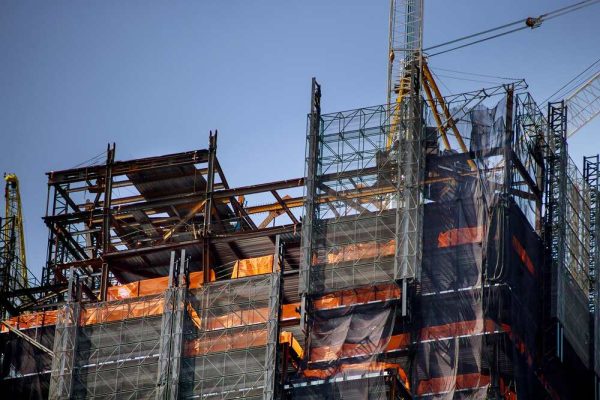
The government has committed to 1.5 million new homes. Infrastructure spending is up. The order books of many contractors look healthier than they have in years. And yet construction has posted more insolvencies than any other UK industry four years in a row.
Nearly 4,000 firms collapsed in 2025. That figure was slightly down on 2024, but it sits 21.5% above pre-pandemic levels. The slight improvement is real. It is not, by any reasonable measure, a recovery.
For contractors, subcontractors, and developers operating in this environment, the risk is not abstract. Supply chains are fragile. The firms around you are under pressure. And when one of them fails, the consequences can land squarely on businesses that did nothing wrong.
This article explains what is driving the numbers, who is most exposed, and what it means for the insurance cover protecting your projects.
The Numbers Behind the Crisis
Construction’s grip on the top of the UK insolvency table has not loosened. According to the Insolvency Service, construction accounted for 17% of all company insolvencies in England and Wales throughout 2025, a share no other sector came close to matching.
The insolvency rate for construction companies in the year to August 2025 was 52.6 per 10,000 companies. That is 23.5% higher than pre-pandemic levels, and a figure that has remained stubbornly elevated despite modest month-on-month improvements in the second half of the year.
Monthly figures have started to ease. November 2025 was the first month to dip below 300 construction insolvencies in some time, and the 12 months to May 2026 showed a 6% reduction on the year before. The structural conditions that produced these numbers, however, have not changed.
Specialist Subcontractors Are Bearing the Brunt
The firms collapsing are not, for the most part, large main contractors making headlines. Specialist subcontractors account for roughly 54% of monthly insolvency totals. Electrical contractors, groundworkers, glazing specialists, mechanical and engineering firms. These are businesses that typically carry out work weeks or months before receiving payment, operating on margins that leave almost no room for error.
In July 2025 alone, 195 specialist firms became insolvent, the highest monthly figure among all construction sub-sectors. Many of these firms had full order books. A full order book, in construction, has never been a guarantee of survival.
Why Does This Keep Happening?
The causes are not new, but they have compounded in a way that has made the last four years particularly brutal.
Fixed-Price Contracts and Costs That Did Not Come Down
Construction firms routinely price work months or years before it is delivered. When materials costs, energy prices, and wages surged through 2022 and 2023, firms locked into fixed-price contracts had no mechanism to recover the difference. Many absorbed losses on job after job until the business could not continue.
Breyer Group, a family firm founded in 1956, folded in April 2025. Its administrators pointed directly to loss-making contracts as the trigger. The firm had revenue and a genuine pipeline. It simply could not deliver that work without losing money on every project.
Inflation has since eased from its peak, but the contracts signed during that period are still unwinding. Many of the construction insolvencies recorded in 2025 and into 2026 are the delayed consequence of pricing decisions made two or three years earlier.
A Payment Culture That Punishes Subcontractors
Late payment is a structural feature of UK construction, not an occasional problem. Only 34% of payments in the sector are made within agreed terms, despite legislation designed to address exactly this issue. Subcontractors pay their workers weekly and purchase materials on 30-day terms, then routinely wait 60 to 90 days for payment on completed work.
That gap has to be financed somehow. At elevated interest rates, bridging that gap with short-term borrowing becomes expensive quickly. For firms already on thin margins, a single delayed certificate or disputed invoice can tip a viable business into crisis.
Regulatory Costs and Building Safety Act Exposure
The Building Safety Act introduced significant new liabilities, particularly for firms involved in high-rise residential work. Ardmore Construction, one of London’s best-known contractors with work dating back to 1974, went into administration in August 2025 after being overwhelmed by fire-safety liability claims. HE Simm, a mechanical and electrical specialist turning over £110 million, followed the same route. The Act was necessary. Its financial impact on firms already operating under margin pressure has been severe.
The Domino You Do Not See Coming
The most immediate risk for many well-run firms is not their own finances. It is what happens when someone else in their supply chain fails.
When ISG collapsed in 2024, it was the sixth-largest contractor in the UK. The impact on its supply chain was enormous. Dozens of subcontractors were left holding unpaid invoices, with little realistic prospect of recovery as unsecured creditors. Some are still working through the consequences.
A typical construction project involves between 20 and 30 subcontractors under a single main contractor. That main contractor is often itself sitting under a developer or principal contractor. A failure anywhere in that structure sends financial shock through every layer below it. Being financially stable yourself provides limited protection if the tier above you collapses and takes your invoices with it.
The firms that navigated this period well ran ongoing credit checks on their main contractors and key clients, not just at the start of a relationship. They also monitored credit insurance status on key counterparties, because when insurers quietly withdraw cover on a business, it is usually months before any formal announcement.
What Happens to Your Insurance Cover
This is where the practical consequences of a counterparty insolvency become most acute, and where many firms are caught off guard.
Contractor-Arranged Policies Do Not Survive Insolvency
When a contractor goes insolvent, their insurance typically lapses. This includes contract works cover, which protects the physical works in progress, and professional indemnity cover, which operates on a claims-made basis and requires an active policy at the point a claim is notified.
If the contractor arranged the project insurance, and they go under mid-build, you may find yourself with an unfinished site and no active cover. Finding replacement cover at that point means going to market in distress, often with restrictive terms, higher excesses, and elevated premiums.
Professional indemnity is particularly exposed. One of the first things an insolvent firm stops paying is its PI premium. Once the policy lapses, there is no valid route to claim, even for defects that were already present in the work.
Who Holds the Policy Is the Question That Matters
The single most effective protection against this scenario is ensuring that the policy is held by the party with the most to lose from it lapsing. When the employer or developer holds the contract works cover directly, the policy does not lapse because a contractor has gone bust.
Owner-controlled or employer-arranged insurance removes the dependency on the contractor’s financial health entirely. It is more commonly used on larger projects, but the principle applies at any scale. If you are unsure whether your current arrangements leave a gap, reviewing who actually holds each policy on your live projects is the right starting point.
For subcontractors, reviewing your own all risk insurance to confirm it covers your exposure regardless of what happens to the main contractor above you is equally important.
Our specialist team can walk through your current cover and identify any gaps. Get in touch to arrange a review.
Practical Steps That Make a Difference

A few specific measures distinguish firms that come through counterparty failures intact from those that do not.
Check who holds the insurance on every project before work starts. If the contractor holds the policy, understand what termination rights you have under your contract and whether you can step in to maintain cover if they show signs of distress.
Run credit checks on clients and main contractors before committing to significant work. Companies House, the Insolvency Register, and specialist construction credit reference agencies all provide useful signals. Late filing of statutory accounts and requests to renegotiate payment terms mid-project are both meaningful warning signs.
Performance bonds can provide some recovery if a contractor fails, but they are typically capped at 10% of the contract value and are not a substitute for correctly structured insurance. They are useful as a layer of protection, not a primary solution.
Trade credit insurance protects your cash flow if a client or contractor fails to pay, whether through formal insolvency or protracted default. For firms working on large contracts with staggered payments, this cover removes a significant source of financial exposure.
Review your contract works cover to confirm it reflects current contract values and project durations. Values agreed at the start of a project can quickly become inadequate as scope changes or programmes extend.
For projects involving residential development, structural warranty cover can also provide a route to protection where defects emerge after a contractor has ceased trading.
A Slight Improvement, but Not a Turning Point
Monthly insolvency figures in construction have softened from their 2023 and early 2025 peaks. Interest rate reductions have eased some pressure on project viability. Government housing investment has given parts of the sector a reason for cautious optimism.
But the BCIS chief economist, commenting in mid-2026, noted that balancing profitability and competitiveness would remain particularly challenging through the second half of the year. Subdued demand in some areas may push contractors to cut prices to win work, recreating the same fixed-price exposure that caused so many construction insolvencies in the first place.
The structural problems that made construction the UK’s most insolvency-affected sector have not been solved. Payment culture has not meaningfully improved. Supply chains remain fragile. Margins in specialist trades are still being squeezed.
The firms best placed to come through the next phase are those treating insurance and financial risk management as part of the same conversation, not separate ones. Understanding what your cover does and does not protect you against, who holds each policy on each project, and where your supply chain exposure actually sits is not optional. In a market where nearly 4,000 firms collapsed last year, it is the difference between absorbing a difficult situation and being taken down by someone else’s failure.
For a no-obligation review of your current cover, speak to our team.